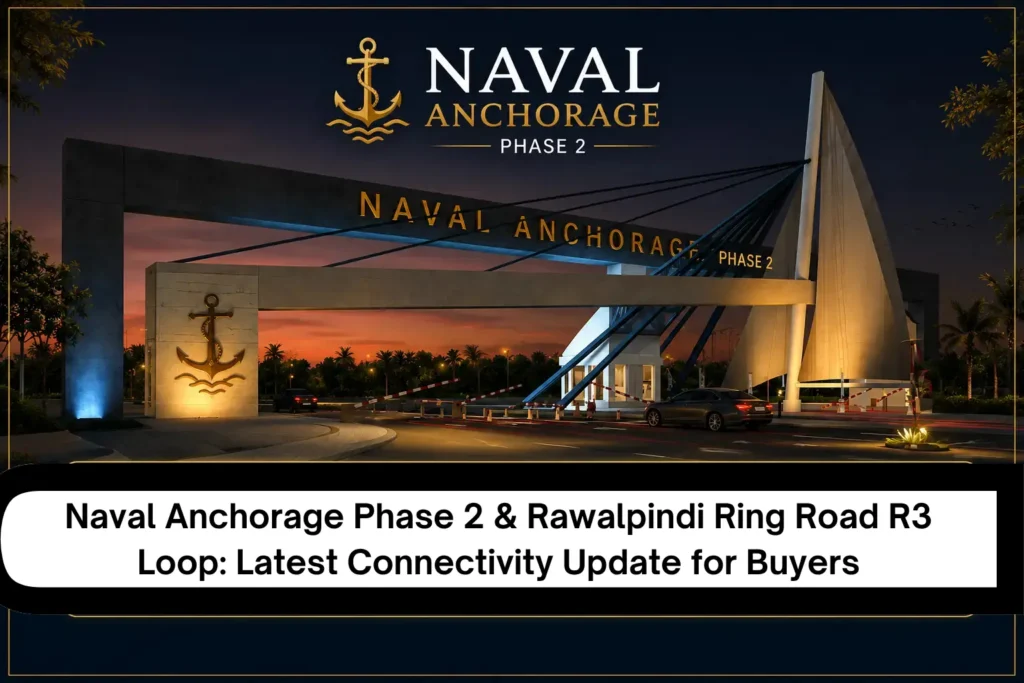
Sit at Committee Chowk around 6 pm on any weekday and you will understand instantly why road connectivity is such a big deal in this city. For anyone looking at Naval Anchorage Phase 2, the Naval Anchorage Ring Road question usually comes up early in the conversation, often before payment plans even get discussed. A society can have the smoothest internal streets in Islamabad, and none of it counts for much if the road leading to the gate is still half finished.
Part of the problem is how loosely these terms get thrown around by marketing teams. Rawalpindi Ring Road, R3 Loop, R3 Route, Thalian Interchange, they all end up in the same sentence as if they mean one thing. They don’t. The Rawalpindi Ring Road, officially the R3 Project, is the road itself. Thalian Interchange is just one access point on it, the one closest to Naval Anchorage Phase 2.
Here’s what’s built, what remains pending, and what buyers should verify before considering it in their investment decision.
How the Naval Anchorage Ring Road Connection Matters for Buyers
Most people don’t think about road access until they’re stuck commuting on it every single day. A society might get its internal roads absolutely right, wide streets, good layout, proper drainage, and still leave residents dealing with a rough fifteen minutes just getting to the main road. That gap is what the Naval Anchorage Ring Road connection is really about.
Internal roads are maybe half the picture. The rest comes down to how fast an ambulance could reach a house during an emergency, or whether a rider on a bike can find the plot without calling twice for directions. Judging two societies purely by how wide their internal streets look on a brochure misses most of what actually affects daily life.
What Is the Rawalpindi Ring Road Project, Exactly?
The Rawalpindi Ring Road, also called R3, is a controlled-access expressway running about 38 kilometres, from the Banth interchange on GT Road near Rawat in the east, to Thalian on the Lahore-Islamabad Motorway in the west. Six lanes. Built for speeds up to 120 km/h. That gives it an advantage over GT Road and Adiala Road, which many Rawalpindi residents use for daily travel.
Because it’s controlled access, you can’t just pull off anywhere along the way. There are only five interchanges on the entire corridor: Banth, Chak Beli Khan, Adiala, Chakri, and Thalian. As of mid-2026, crews have carpeted most of the main carriageway. Reports also indicate that four of the five interchanges are complete or nearing completion. Thalian is the one still lagging. Authorities have moved the full interchange to a later, separately funded NHA phase. Until construction begins, a temporary widened carriageway connects the Ring Road with the motorway. If you want to track how this is moving, the project’s development update is worth bookmarking.
Where the R3 Route Connects With Naval Anchorage Phase 2
People keep calling it a loop, but that’s a bit misleading. R3 is simply the project code for the Rawalpindi Ring Road. It isn’t a closed circle around the city despite the name. It runs as a straight corridor from GT Road to the motorway, and the whole point is to pull heavy and intercity traffic away from the city centre instead of routing it back through the same streets everyone already avoids.
For residents of Naval Anchorage Phase 2, this corridor should eventually mean a quicker path onto the motorway network without having to cross central Rawalpindi first. Getting to the airport corridor should get easier too, since Thalian sits close to the M-2 approach toward New Islamabad International Airport. There’s a separate breakdown on the airport corridor development page if that side of things interests you specifically.
Worth keeping in mind though, timelines on this project have already moved more than once. Thalian’s interchange is funded, it’s on the plan, but it isn’t built. So this is a route that’s still forming, not one that’s already delivering results on the ground.
Why Thalian Interchange Is the One That Matters
Interchanges do the unglamorous job of letting traffic move between major roads without cutting through neighbourhoods. Thalian is the one buyers should actually care about here, mostly because of the strategic location near Thalian Interchange that ties Naval Anchorage Phase 2 into the wider network.
Being close to a major interchange is a real plus. But the driving distance can end up longer than what proximity on a map suggests, and that catches people off guard more often than you’d think. Once the corridor is fully functional, the Ring Road may reduce the travel time between Rawalpindi and Chakri by almost an hour, officials said. That figure applies to the finished road though, not necessarily where things stand today. For the latest picture, check the Thalian Interchange development page directly.
Reading a Rawalpindi Ring Road Map the Right Way
A lot of buyers look at a map with a line running near the project and assume that settles the access question. It usually doesn’t. This is honestly where most of the confusion in the market starts.
Since this is a controlled-access road, entry and exit only happen at one of the five interchanges. Not anywhere else along the route. Before assuming easy access, figure out which interchange actually serves the area, and measure that distance from the project gate rather than from the highway line on a brochure. Checking the master plan alongside the Ring Road map helps here.
And don’t judge connectivity by distance alone. A plot can look close to a highway on paper and still mean a longer drive in reality, simply because the nearest access point is a few kilometres off. The distance shown on a Naval Anchorage Phase 2 map rarely tells the full story by itself.
How Better Road Connectivity Can Benefit Naval Anchorage Phase 2
Once the corridor opens fully, residents should be able to skip some of the worst congestion on GT Road and Murree Road while heading toward the motorway. Even a twenty-minute saving on the daily commute adds up meaningfully over a year, especially for anyone travelling regularly between Islamabad and Rawalpindi.
It isn’t only about the resident driving to work either. Delivery riders, electricians, plumbers, relatives coming over for the weekend, they all depend on the same access points. Whether a place actually works for families often comes down to how easily people from outside can find the house, not just how the layout looks inside it. There’s more on this in the piece about why Naval Anchorage is a practical choice for families.
As for demand, better road access does tend to make a location more attractive to buyers over time. It just doesn’t automatically mean prices go up. Development pace, possession status, and general market conditions usually carry more weight than any one road project, no matter how well built it turns out to be. Read the property boom coverage with that in mind.
What Buyers Should Check About the Naval Anchorage Ring Road
Given how many times deadlines on this project have shifted already, a little independent checking goes a long way. Before treating any connectivity claim as settled fact:
- Check the latest official project updates instead of an old brochure or listing.
- Confirm whether Thalian specifically is operational or still under construction.
- Compare the current route map against older versions and see what’s genuinely changed.
- Visit the site yourself and check the access points, ideally using the location page as a starting reference.
- Don’t base your booking decision on infrastructure that is promised but not yet delivered.
Planned and operational are not the same thing. Mixing them up is probably the most common mistake buyers make in this market. A road marked “complete” on a project document can still be a year or more away from actually functioning as one on the ground. Checking the project’s current NOC status is a sensible part of that same homework.
Should the Ring Road Affect Your Investment Decision?
Connectivity is a fair thing to weigh. Simply don’t make it heavier than it is supposed to be.
These are real benefits if the construction is not in a document somewhere but actually visible on site, and with easier access and an interchange nearby, and with less reliance on congested city roads for driving in or out. However, approvals, plot location, and possession date are as important, if not more so, than the road. Spend time on the payment plan, the current market rates, and resale demand before finalising anything. A broader investment guide can round out the picture alongside whatever you find on the road front.
Quick Snapshot
- Main topic: Naval Anchorage Ring Road
- Major regional route: Rawalpindi Ring Road (R3 Project), roughly 38 km, GT Road to M-2 Motorway
- Key interchange: Thalian, nearest access point to Naval Anchorage Phase 2
- Relevant infrastructure: R3 Loop / R3 Route
- What buyers should assess: actual access points, route condition, and the latest development status
What This Looks Like in Real Life
A road on a brochure is just a line between two points. In real life, someone leaves the house, drives to the nearest interchange, merges onto the corridor, and eventually gets where they’re going. That actual drive is what determines whether the connectivity is useful, not how close the project looks on a map.
Buyers who get this tend to ask better questions before booking. Things like how long the drive to the nearest interchange really takes right now, rather than trusting how the distance reads on paper.
Where This Leaves Buyers
At this point, the Rawalpindi Ring Road is largely built. Thalian Interchange, the piece that actually matters for Naval Anchorage Phase 2, is still working its way through a separate construction phase. Anyone considering a purchase should keep this gap in mind rather than assume the connectivity story is complete.
Check the latest map. Confirm what’s actually complete on the ground. Look at the project’s legal and development standing alongside whatever the road updates say. Connectivity is one useful piece of this decision, not the whole thing.
Frequently Asked Questions
Q1: How does the Rawalpindi Ring Road relate to Naval Anchorage Phase 2?
Ans: The Ring Road connects GT Road with the M-2 Motorway. Thalian is its westernmost interchange and lies closest to Naval Anchorage Phase 2. It’s the main link between the project and the wider road network.
Q2: What is the R3 Loop?
Ans: R3 is just the project name for the Rawalpindi Ring Road. It’s a straight corridor, not a closed loop, connecting GT Road to the motorway through five interchanges.
Q3: Why is Thalian Interchange important for buyers?
Ans: It connects the Ring Road to the M-2 Motorway and, from there, toward the airport corridor. How fast it gets finished determines when the connectivity benefit actually becomes real for nearby projects like this one.
Q4: Does the Rawalpindi Ring Road guarantee higher property prices?
Ans: Better accessibility can support demand. However, prices depend on several factors, including development pace, possession status, and market conditions.not one road alone.
Q5: How should buyers check the latest Ring Road map?
Ans: Use current official updates instead of old marketing maps. Compare recent versions with earlier maps to identify genuine changes.
Q6: Should I buy a plot just because of the proposed Ring Road connection?
Ans: No. Treat it as one factor among several, alongside development status, legal standing, possession timelines, and current market rates.