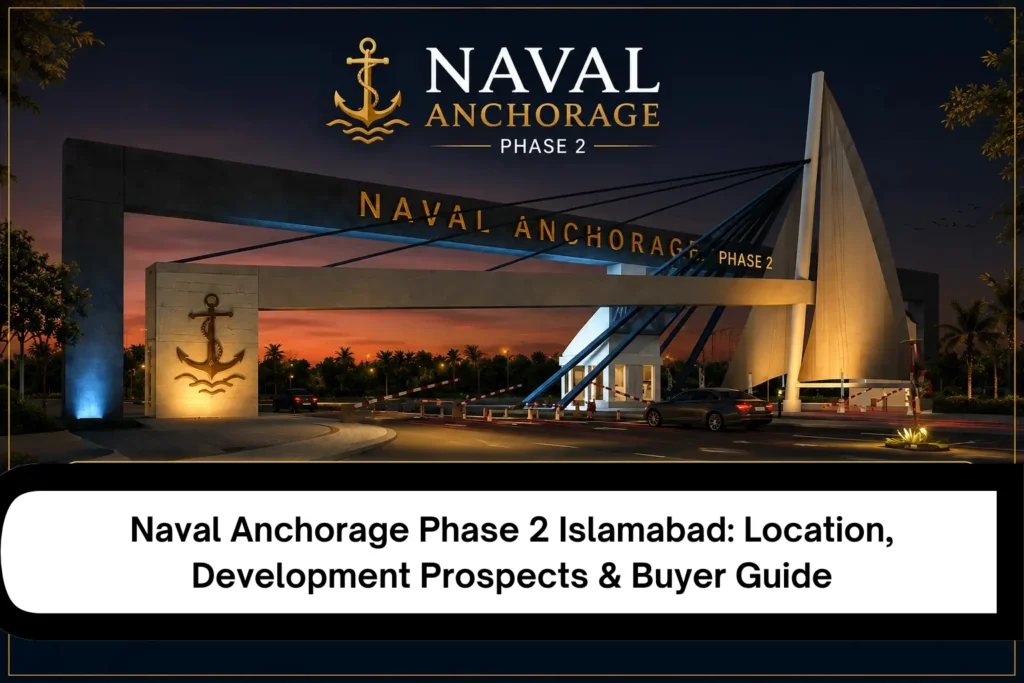
Picture this. You find a plot in a good-looking location, the installment plan feels easy, and the dealer is friendly. Does any of that tell you the plot is documented, developed or ready to hold? Not really. In fact, plenty of buyers only ask that question after they’ve paid. This guide looks at Naval Anchorage Phase 2 Islamabad from four sides: where it sits, how you reach it, what proof of development exists and which papers back up a purchase. Anyone studying the Naval Anchorage Prospects also needs to know the gap between a nearby road, a working entrance and a road that’s merely proposed. The same goes for Thalian Interchange and the M-2 Motorway. Throughout, I’ll keep marketing claims apart from records you can check, and then I’ll finish with steps you can run yourself.
Project Overview Table
| Detail | Current position |
| Project name | Naval Anchorage Phase 2 |
| General location | Marketed as near Thalian Interchange, Islamabad. Exact boundaries not independently verified |
| Road access | Direct entrance to the interchange or M-2 not independently verified |
| Developer or sponsoring organization | Developer-stated. Check the about us page and ask for supporting documents |
| Approval status | Phase 2 status unresolved in the evidence reviewed. An original scheme record exists separately |
| Master plan | Developer-published plan available. Authority approval not independently verified |
| Residential plot sizes | Developer-stated categories only. Confirm in the current written schedule |
| Commercial plot sizes | Developer-stated, see the commercial plots page |
| Payment plan | Developer-published. Date and version need confirmation |
| Development status | Developer-stated and reported activity. Plot-level readiness unverified |
| Main buyer precaution | Verify the land, phase, plot and payment documents before paying |
Naval Anchorage Phase 2 Islamabad Overview
Naval Anchorage Phase 2 is sold as a mixed residential and commercial project. Its promoters present it as the second phase of the Naval Anchorage name. So Naval Anchorage Islamabad now points to more than one stretch of land, and each stretch has its own paperwork. Mixing them up is the easiest mistake a buyer can make.
Here’s what the Capital Development Authority (CDA) shows. Its housing-scheme record for Naval Anchorage lists 3,702.70 kanals, an LOP approval date of 27 February 2020 and an NOC issuance date of 28 May 2020. Those details describe the scheme named in that record. However, they say nothing, by themselves, about Phase 2 land. A document would have to connect the two before anyone could call it Phase 2 approval.
There’s a second lead as well. A secondary compilation mentions a CDA notice dated 1 June 2026 about land marketed as Naval Anchorage Phase-II, along with a separate Block-A matter. I treat that as a pointer, nothing more. You’d have to read the original notice first. Until then, saying Phase 2 is approved would be unfair, and so would saying it’s rejected.
In short, names, associations and brochures tell you what a seller says. They don’t tell you what an authority has recorded. The rest of this guide is about closing that gap.
Naval Anchorage Location and Accessibility
A location only helps when you can measure it. After all, “minutes away” usually hides the route, the traffic and the exact entry point.
Where Is Naval Anchorage Phase 2 Located?
Most descriptions place the project near the Thalian Interchange area, on the Islamabad side of the M-2 corridor. The developer says so on its location page. Therefore, this is a developer-stated description and not an authority-verified one.
Sources don’t always agree on whether a project is near a road, off it or directly on it. So ask for something firmer, like khasra numbers or mapped boundaries. A marketing map can’t settle the Naval Anchorage Location question alone, and coordinates should only be published once they match an authenticated plan. The map post shows how the developer presents the site. It works for comparison, but don’t treat it as proof.
Connection to Thalian Interchange and the M-2 Motorway
Close and connected aren’t the same word. In practice you’ll meet one of four situations: a direct working entrance from the interchange or motorway, access through an existing connecting road, a road under construction, or a proposed road or interchange. Each one changes your daily travel in a different way. Meanwhile, a dealer’s route description doesn’t fit any of them until someone confirms it.
So ask a few plain questions. Which road would a resident use today? Where does it begin? Who built it? The developer’s Thalian Interchange post and interchange development post give the project’s own view. Before leaning on either, check both against National Highway Authority information.
Likewise, if someone quotes a driving distance, find out where it starts, where it ends and when it was measured. A straight-line figure can understate the real trip by a wide margin.
Access to Islamabad International Airport
The airport lies in the same general part of the capital region, so a link to the project is plausible and worth checking. However, “five minutes from the airport” needs a named route and a measured time behind it. Traffic, route choice and road condition all move the number. Without a stated route, call it a marketing estimate. The airport corridor post shows the developer’s take.
Nearby Areas and Surrounding Infrastructure
Nearby housing schemes, villages and commercial zones only strengthen a case once their position is established. Besides, a working road, a road under construction and an announced plan are three different things. Sitting close to any of them won’t raise a plot’s value on its own.
Naval Anchorage Prospects: Development and Future Potential
This section asks what could strengthen or weaken future demand. It doesn’t forecast returns. Instead, most honest answers about Naval Anchorage Prospects come down to evidence you can go and check yourself.
Current Development Evidence
Good evidence is practical: internal roads, plot demarcation, drainage, electricity, water, visible construction and possession activity. The developer’s development update and latest update describe progress from its own side. Because they’re developer-stated, you should ask for dates, photos and block-wise detail.
I haven’t visited the site, and I won’t pretend to know how it looks today. Instead, ask for dated proof for your exact block. For example, a phrase like “rapid development” means little without a milestone and a date next to it.
Infrastructure and Accessibility Factors
Usable roads shape daily travel, construction logistics and buyer interest. A plot you can reach easily is simply more practical. Still, an announced interchange or link road doesn’t prove anyone has funded, built or opened it. So look up the responsible authority’s latest documents and the real completion status. Then ask yourself something blunt: does this plot still work for me if that road arrives late?
Factors That Could Influence Future Property Demand
Demand rarely hangs on one thing. Road access and travel convenience matter, but so do planning and land documentation, how far development and possession have actually come, and whether electricity, water and drainage are reliable. In addition, think about demand in comparable nearby locations, asking prices set against real transactions, your own ability to keep paying, competing projects and the ease of verifying a plot or file at resale.
These factors lean on each other. For example, a reachable location may draw interest, yet unclear papers or missing utilities can make a buyer walk away. Similarly, a low booking amount can look comfortable while hiding a large balance. Even so, none of it guarantees capital appreciation.
Risks That Could Affect Development Prospects
Treat these as things to investigate, not accusations. A gap in information doesn’t prove wrongdoing, but you should close it before taking on financial exposure.
The biggest risk is incomplete phase-specific documentation. Close behind are delays in roads or utilities, and differences between advertised and documented boundaries. Meanwhile, possession conditions can stay vague and payment schedules can conflict. Evidence of completed transactions may be thin, the whole case may lean on future infrastructure, and file transfers or resale claims can be hard to confirm. Finally, project terms and charges can also change.
Put together, the prospects depend on location, development, documentation and affordability as a group. Therefore, strength in one can’t cover weakness in another.
Naval Anchorage Phase 2 Official Information and Approval Checks
Sellers use the word “official” loosely. A page on a project website is official only because the project published it. An authority record, on the other hand, is a different animal.
What Should Buyers Know About the Naval Anchorage NOC?
A No Objection Certificate is a specific regulatory document. Its weight depends on who issued it, what land it covers and which conditions it carries. The Naval Anchorage NOC dated 28 May 2020 in the CDA record belongs to the scheme named there. For Phase 2, then, you need a document that names the phase and ties it to the land in question.
Think of a ladder. A registration record shows an organization exists. An application shows someone asked for approval. Next, a proposed plan shows intent. Only an approved layout plan and an issued NOC show an authority has acted. Each rung means something different.
For any Phase 2 record, check the project and phase named, the land area and boundaries, the issuing authority, the reference number and issue date, and any conditions, amendments or later notices. The developer’s NOC status post gives its own account, so read it next to the authority’s records. If a notice exists, report its exact wording and scope. Remember that a notice isn’t a final ruling, and a developer’s reply doesn’t cancel a notice unless an official record says so.
Verify the Layout Plan and Approved Area
Three kinds of plans float around, and buyers mix them up all the time. A proposed master plan describes an intended design. A developer-published plan comes from the sales side and may or may not carry approval. By contrast, an authority-approved layout plan has a record at the competent authority.
A logo, a designer’s name or a heading that says “official master plan” proves none of this. Instead, compare your plot or block with the authenticated plan and the documented land boundaries.
How to Verify Naval Anchorage Phase 2 Official Records
Work through it in this order:
- First, identify the authority responsible for the exact land.
- Then get the record or document reference.
- Match the project name and phase.
- Confirm the approved area and boundaries.
- Check whether your block or plot falls inside that record.
- Review notices, conditions and amendments.
- If the record is unclear, ask the authority for written clarification.
- Finally, keep copies of every document you relied on.
Remember, developer registration and general marketing claims don’t establish approval for every scheme or phase.
Naval Anchorage Master Plan and Plot Information
How to Assess the Naval Anchorage Master Plan
Begin by finding out whether a dated, authenticated plan exists and who issued it. The master plan page shows the developer’s published version. Until an authority says otherwise, call it developer-published.
Then read what the plan actually shows: project and block boundaries, plot numbering and categories, the road hierarchy, residential and commercial zones, parks, utility corridors and public facilities. Compare earlier and later versions too, since changes between them can matter.
Also, who designed a plan isn’t the same as who approved it. A nicely drawn plan can still lack an authority’s sign-off.
Residential and Commercial Plot Sizes
Residential and commercial categories should be listed separately and taken from current documents. The developer lists commercial options on its commercial plots page. If two sources disagree, point out the difference and ask for the current written schedule and allotment terms. After all, a general category in a brochure can’t tell you an individual plot’s exact size, position or legal status.
How to Verify a Specific Plot or File
The plots versus file post explains the developer’s view of the difference. Beyond that, go straight to the issuing organization and confirm the file or plot number, the block and category, the seller’s identity and transfer rights, and the allotment and transfer history. Ask about outstanding installments and development charges, any restrictions or encumbrances, possession eligibility, and whether everything matches the authenticated plan.
If doubts remain, get independent legal advice. Above all, a file and a documented plot aren’t the same product, so don’t compare them as if they were.
Naval Anchorage Payment Plan and Plot Prices Islamabad
How to Read the Naval Anchorage Payment Plan
You’ll find several versions online. The developer posts its own on the payment plan page, and again in the 2026 payment plan and latest payment plan posts. So note the date and source of whichever one you use, and never blend two schedules into one.
A complete schedule should spell out the booking or down payment, installment size and duration, and any ballot or allocation charges. It should also cover development and possession charges, transfer fees and taxes, discounts or premiums, and what happens on late payment or cancellation.
Say two pages quote different booking percentages. Don’t pick the nicer one. Instead, show the difference and ask for written confirmation. Keep in mind that a payment plan tells you what a page advertises. It doesn’t prove approval or the validity of a plot.
How to Evaluate Plot Prices Islamabad Buyers May Encounter
Plot Prices Islamabad come in several forms, and each means something different. A developer’s published price isn’t a dealer’s quote. Likewise, a dealer’s quote isn’t an online asking price. None of those equals a completed sale, and file prices and prices for plots with documented possession eligibility sit in separate categories again.
I haven’t added a price table. Without dated, checked listings it would be guesswork, so I won’t invent a market average. When you collect listings yourself, write down the date, the plot category and the source. Compare like with like, because a file without possession isn’t the same as a plot with documented possession eligibility. In the end, an asking price is never a sale price.
Calculate the Full Cost Before Booking
Use this formula:
Total estimated commitment = booking payment + scheduled installments + balloon payments + documented additional charges + applicable taxes and transfer costs.
Add development charges, possession charges and premiums only when the written terms establish them. Here’s a made-up example, just to show the method. Say a plot costs PKR 10,000,000, booking is PKR 2,000,000 and balloon payments total PKR 1,000,000. That leaves PKR 7,000,000 for installments, before any extra charges. As you can see, a small first payment can still leave a big liability behind it. This isn’t an official quotation.
Facilities, Utilities, Possession and Livability
Existing Facilities Versus Planned Amenities
Sort every facility into one of five groups: operational and verified, under construction, developer-stated, planned, or not independently verified. The facilities and amenities page and the premium facilities post describe what the developer promotes. However, a feature in a brochure isn’t a working service. So ask for proof of electricity, water, sewerage, drainage, security and parks in your own block.
Possession and Construction Readiness
Booking, allocation, allotment, possession and permission to build are separate stages. Clearing one doesn’t mean you’ve reached the next. Therefore, ask for written evidence that possession applies to your specific plot, plus the outstanding dues, the possession documents required, the construction conditions, utility connection requirements and any authority restrictions. If nobody can show a contract or official record behind a possession date, don’t accept the date.
Buyer Guide: What to Check Before Purchasing
Legal and Documentation Checklist
Before you pay, go through this list:
- Identify the competent authority and verify the phase-specific record.
- Confirm land boundaries and the approved area.
- Obtain and authenticate the layout plan.
- Verify the seller’s identity and transfer rights.
- Confirm the file or plot with the issuing organization.
- Get a written statement of dues and charges.
- Review booking, cancellation and refund terms.
- Confirm the authorized payment channel and keep receipts.
- Establish possession and construction eligibility.
- If material issues remain, seek legal advice.
This list supports due diligence, but it doesn’t replace professional legal verification.
Questions to Ask the Developer or Authorized Office
You can reach the sales team through the contact page. Ask the questions below, and ask for the answers in writing.
- Which authority is responsible for this location?
- What record establishes this phase’s current status?
- Can I have the document reference and the authenticated plan?
- Does my plot fall inside the documented boundary?
- What is the development status of my block?
- Which charges remain after booking?
- What document proves possession eligibility?
- How can I verify the file or plot independently?
- What are the transfer, cancellation and refund procedures?
- Has any notice, amendment or restriction affected the plot?
After all, spoken promises count for very little. Paper counts.
Warning Signs Buyers Should Investigate
Stop and look closer if the seller can’t show approval documents, or if the papers name a different phase or land parcel. The same goes when someone discourages independent verification, or asks you to pay into an unverified personal account. Plot numbers that differ across records are another flag, as is a payment schedule that changes with no written explanation. Likewise, be wary of possession claims without documents, and of a seller who can’t explain dues or transfer requirements.
A mismatch isn’t automatically fraud. Still, it’s a problem that needs an answer before you pay.
Who Should Consider Further Research Into Naval Anchorage Phase 2?
What you need to check depends on your purpose, your budget and how much uncertainty you can live with.
Buyers Planning Future Construction
Start with approvals, documented plot identity, utilities, possession eligibility and practical access.
Buyers Requiring Immediate Possession
Look for plot-specific possession papers, construction conditions, dues and proof of working services. A general development claim won’t do.
Overseas Pakistanis
Verify records directly, get authenticated copies and confirm payment instructions through an independent channel. Where needed, a qualified local lawyer can help.
Buyers With Limited Financial Flexibility
Work out the full obligation, including balloon payments and extra charges. Then test whether the schedule still works if your expenses rise or your income drops.
Buyers Depending on Future Infrastructure
Separate the roads that exist from the ones that are planned. Then ask whether the plot still suits you if a proposed road or interchange arrives late.
Buyers Prioritizing Documented Approval and Utilities
Establish the approval scope and service availability first. Afterward, compare prices and amenities.
Conclusion
Verified location and road access matter, but they’re only one piece. You also need proof of real development, working utilities and clear possession terms. Moreover, keep the original Naval Anchorage records apart from Phase 2 documents, and authenticate both the master plan and the individual plot record. Current payment terms and dated market evidence fill in the rest. Anyone weighing the Naval Anchorage Prospects should calculate the full financial commitment, not just the first payment. So the next step is simple: collect the documents, confirm their scope with the authority or issuing organization, work out the total cost and settle every material doubt before you pay.
Frequently Asked Questions
Q1: Where Is Naval Anchorage Phase 2 Islamabad Located?
Ans: It’s marketed as lying near the Thalian Interchange area in Islamabad. That description comes from the developer and hasn’t been independently verified. So ask for mapped boundaries and land references, and confirm which road gives real entry before you treat any description as settled.
Q2: What Are the Main Naval Anchorage Prospects?
Ans: The main factors are verified access, documented development, utility readiness, approvals, market evidence and affordability. Some may support future demand, while others remain uncertain. Still, a good location doesn’t prove financial performance, and nobody can guarantee appreciation.
Q3: Is the Naval Anchorage NOC Verified for Phase 2?
Ans: The evidence reviewed doesn’t settle it. A CDA record exists for Naval Anchorage with an NOC date of 28 May 2020, but it covers the scheme named there. Therefore, buyers need a record that links Phase 2 land to an approval. A missing document alone proves neither approval nor rejection.
Q4: How Can I Check the Naval Anchorage Master Plan?
Ans: Ask for the plan with its date and issuing organization. Then ask the relevant authority whether it approved that plan. Next, compare boundaries, blocks and plot numbers with your own papers. The developer’s master plan page is a starting point, not proof of approval.
Q5: Where Can I Find the Naval Anchorage Payment Plan?
Ans: The developer publishes versions on its payment plan page. Since versions can differ, request the current written schedule. It should state installments, balloon payments, extra charges, discounts and cancellation terms.
Q6: How Should I Compare Plot Prices Islamabad Listings?
Ans: Separate developer prices, dealer quotes, online asking prices and completed sales. Then compare similar plot categories and dates. Also allow for possession status, outstanding dues and extra charges. Remember that an advertised price doesn’t prove anyone actually paid it.