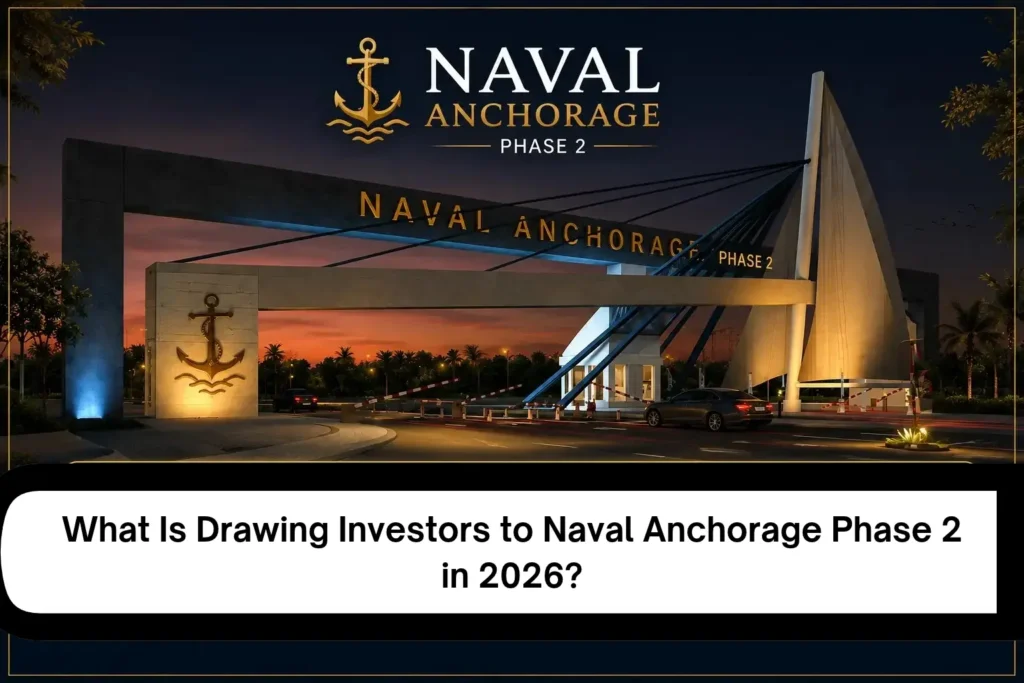
Say you’re scrolling through Naval Anchorage Property ads late at night. The price looks low. The motorway is mentioned twice. The instalment table seems friendly. It’s easy to feel that you’ve found something good. But none of that tells you if the land has an approved layout, if the seller can legally pass it on to you, or if there’s a single finished road at the site.
People searching for Naval Anchorage Phase 2 usually want answers on five things: where it is, what it costs, how payment works, what’s planned, and whether it’s legal. Treat each one separately. A cheap price says nothing about title. A planned park says nothing about what’s built today.
So here’s what this guide does. It looks at why buyers might be interested, shows what the evidence supports, flags what’s still unknown, and gives you checks to run before any money moves.
Naval Anchorage Property: Key Factors Before Buying
| Evaluation factor | Why it matters | Evidence required |
| Location | Determines practical access and geographic suitability. | Exact land identification, credible maps, and verified routes. |
| Approval | Influences legal and planning risk. | Relevant authority records for the precise phase and land parcel. |
| Price | Determines the initial cost. | Dated, comparable listings and verified contractual figures. |
| Payment terms | Determine future cash obligations. | Written schedule, total payable amount, and applicable charges. |
| Development | Influences usability and possible possession. | Current documented progress and applicable approvals. |
| Ownership | Affects the buyer’s rights and transfer options. | Property-specific ownership and transfer documents. |
| Resale | Affects the ability to exit. | Comparable listings, completed sales where available, and transfer requirements. |
Why Buyers Consider Naval Anchorage Property in 2026
Let’s be upfront. The title asks what is drawing investors, but I found no source that actually measures a rise in investor demand for this project. What follows are reasons a buyer might look. They aren’t proof of a trend.
Naval Anchorage Property and the Islamabad Market
Plenty of people look at housing around Islamabad and Rawalpindi. Jobs are nearby, the roads connect to the wider region, and families need somewhere to live. A busy property market also means a buyer can compare many options.
That said, a healthy city market doesn’t lift every scheme equally. Some projects have clean approvals and finished roads. Others have a brochure. Each housing society has to be judged on its own record.
Comparing Plot Prices and Entry Costs
Price is what most people notice first. A small booking amount feels easy, and a long schedule makes the commitment feel lighter than it is. That’s a fair reason to take a second look.
It’s a poor reason to commit, though. A low entry price can hide a weak approval position or heavy charges later. Ownership, development, dues, and your exit options often matter more than the headline number.
Expectations About Future Development
Buyers are drawn to what a project promises. The developer’s facilities and amenities and master plan pages show a lot of it. They help you picture the place. They don’t prove any of it exists, and a drawing isn’t a commitment recorded by the authority.
What the Available Evidence Actually Establishes
Developer claims tell you what the sponsor says it wants to offer. Dealer talk adds colour, not data. The one official record I found for Phase 2, covered below, raises real approval questions. So yes, there are reasons to look into this project. Whether it suits you is a separate decision.
Naval Anchorage Location and Regional Connectivity
Identifying the Exact Location of Phase 2
The strongest evidence is a CDA notice dated 1 June 2026. It places “Naval Anchorage (Phase-II)” in Zone-5, Islamabad, across roughly 5,500 kanals. Marketing sites put the project at the Thalian Interchange on the M-2 Motorway. That’s the developer’s description, and I couldn’t match it to an official map.
Area figures don’t agree either. One dealer website says 15,500 kanals. The CDA notice says about 5,500. A gap that big is a signal. Ask for a land identification document before you believe any location claim.
Also keep the original Naval Anchorage apart in your head. CDA’s directory lists it in Zone-5 with its own area figure. Its address and approvals don’t automatically carry over to Phase 2.
Access to Major Roads and Nearby Developments
Developer material talks about the Thalian Interchange, the M-2, and the airport corridor. Our own pages cover the strategic location near the Thalian Interchange and the airport corridor. Read those as the developer’s view. I didn’t verify any distances or travel times, so you won’t find any here.
Being close to a road doesn’t mean there’s a direct way in. Find out how a car actually reaches your plot.
What Connectivity Means for Residents and Buyers
A map pin doesn’t tell you what a Tuesday morning commute looks like. Schools, hospitals, markets, and transport all decide whether a plot works for your family. Keep one distinction in mind: what the project plans to build inside its boundary is different from what already exists around it.
How to Evaluate a Location Claim
Three checks will save you trouble:
- Match the exact land to an official or surveyed document.
- Drive the route yourself, or send someone you trust, and note the date.
- Keep verified geography apart from developer or dealer estimates.
Our Naval Anchorage location page and map guide are good for orientation. They won’t replace the land check.
Approval Status and Legal Due Diligence
Why Approval for One Phase Does Not Establish Approval for Another
A project name is just a name. The original Naval Anchorage and Phase 2 each need their own check of layout plans, land records, and conditions.
A few terms are worth knowing. A layout plan shows how the land is split into plots, roads, and amenities. An NOC is the authority’s no objection certificate for the scheme. Separate planning permission may apply as well. And a master plan stays a proposal until the authority approves it. Rules can differ from one project to another, so check every document against the exact scheme.
Naval Anchorage Property: Investigating the CDA Notice
I pulled the original from the CDA website. It’s a Final Show Cause Notice dated 1 June 2026, issued by the CDA Directorate of Housing Societies to the Director Anchorages (North) at Naval Anchorage.
The notice says development works for Naval Anchorage (Phase-II), covering about 5,500 kanals in Zone-5, started without an approved layout plan or CDA NOC. It states the same about Naval Anchorage (Block-A), covering around 435 kanals. For Block-A, it adds that most of the land falls within the approved layout of Jinnah Garden (Phase-I Extension) and is earmarked for public amenities.
Naval Anchorage Property: CDA Notice and Orders
The orders require development, marketing, and buying or selling to stop within seven days, along with the removal of the structures concerned. The notice also provides for a personal hearing within that period and lists possible consequences, including demolition, suspended building plan approvals, and sealed offices. It asks IESCO and SNGPL to provide connections only in line with an approved layout.
These directions record CDA’s position on 1 June 2026. They do not establish what happened after the notice was issued, and the seven-day period has long since passed.
Naval Anchorage Property: Phase 2 NOC Status in 2026
On 17 October 2026, I checked CDA’s housing directory. Its Naval Anchorage page lists two notices dated 1 June 2026. It also records the original project’s layout approval on 27 February 2020 and its NOC issuance on 28 May 2020. I found no later notice, court order, or approval for Phase 2. However, not finding a subsequent record during my search does not prove that none exists.
Marketing sources also disagree. One property website lists the Phase 2 NOC as approved, while others say no confirmed NOC has been disclosed. The CDA notice remains the strongest official record I found on this issue. Our NOC status guide and latest update examine the issue further, but developer pages and property listings cannot replace an official CDA record.
How to Verify the Current Approval Position
Contact CDA’s Directorate of Housing Societies and ask for records on your exact phase and land parcel. Ask for the approved layout plan, the NOC, and any notice or order issued after 1 June 2026. Then compare the project name, area, and block in those papers with what’s printed on your brochure or receipt. If something doesn’t match, ask why before paying.
Ownership and Transfer Checks
Find out who legally owns or controls the land. Confirm the seller can transfer what they’re offering. Ask what you’re really buying: a registered plot, an allotment, a booking entitlement, or something else. Look for unpaid dues and transfer restrictions. And note which entity takes your money and what paper proves it.
Our guide to plots versus files explains why the type of interest matters so much. If any answer feels vague, get a local lawyer to review it. This article doesn’t accuse anyone of wrongdoing. It sticks to the documents cited.
Naval Anchorage Property Prices and the Actual Cost of Buying
Understand What an Advertised Price Represents
Four kinds of numbers float around. The developer publishes one. A dealer quotes another. A listing shows an asking price. And a completed sale shows what someone really paid. Only that last one reflects the market, and I found no verified completed sale for Phase 2.
I did find one Phase 2 marketing page for commercial plots. I checked it on 17 October 2026, and I couldn’t tell when it was first published.
| Item | Figure on the page | Status |
| 4 marla commercial plot, total price | PKR 20,000,000 | Developer-stated, unverified |
| Booking (15%) | PKR 3,000,000 | Calculated, matches 15% of total |
| Confirmation (10%) | PKR 2,000,000 | Calculated from the stated percentage |
| Balance after both | PKR 15,000,000 | Calculated |
One ad can’t set the rate for a whole project. And don’t blend these numbers with listings for the original Naval Anchorage.
Calculate the Full Acquisition Cost
The real bill can include booking and down payment, scheduled instalments, development charges, transfer and documentation fees, taxes, outstanding dues, and late-payment charges. Count only what your agreement states. Everything else goes on your list of questions.
Compare Equivalent Properties
Compare the same plot size, phase, block, payment terms, ownership type, and development stage. A transferable plot and an unverified booking entitlement are different things, even at the same price. Our investment guide for 2026 is a decent place to start digging.
When Price Information Is Incomplete
If there are no reliable comparables, then no verified market-wide price exists for this project. Build your own benchmark instead. Collect three or four dated quotations and write down the plot size, block, price, payment terms, and source for each. It takes an evening, and it beats trusting one number.
Payment Plan and Buyer Affordability
Why Instalments May Attract Buyers
Instalments spread the cost over months or years, and a small booking amount is easy to say yes to. Fair enough. Most of us don’t have the full amount sitting around.
But a small first payment doesn’t make the total smaller, and it doesn’t make the deal safer. The commercial plot page describes a 15% booking, a 10% confirmation payment, 36 monthly instalments, six half-yearly payments, and a final possession charge. It also advertises a 15% discount for paying in one lump sum.
What the Written Payment Schedule Must Show
Ask for a document that states:
- The total price.
- The booking amount.
- Down payment and confirmation payments.
- How many instalments there are and how often they fall due.
- Any balloon or periodic payments.
- Development and possession charges.
- Discounts and what conditions come with them.
- Late-payment penalties.
- Cancellation, refund, and transfer terms.
Compare it with our payment plan page, then ask for a signed copy.
Reconcile the Total Payment
Add up every amount in the schedule and compare it with the stated total. In the example above, booking plus confirmation is PKR 5,000,000, which leaves PKR 15,000,000. The page didn’t state the individual instalment or possession amounts, so I couldn’t reconcile the full total.
Here’s another case. If the 15% discount applied to the whole PKR 20,000,000, the lump-sum price would be PKR 17,000,000. That’s my assumption, since the page doesn’t say what the discount applies to. Get the seller to confirm it in writing.
Avoid Unsupported Phase-Specific Claims
Don’t apply a payment plan from the original project or another block to Phase 2 unless you have written confirmation. Our 2026 payment plan article works as a source of questions to ask, not as an answer.
Development Progress, Infrastructure, and Practical Usability
Planned Work Versus Completed Development
Planned roads, advertised parks, and commercial zones aren’t finished infrastructure. Digging isn’t the same as a completed road either. One marketing page says Phase 2 is in an early development phase with groundwork underway. Another calls it pre-launch. Those two descriptions can’t both be right, and I couldn’t verify either.
For every feature you care about, check who says it exists and what stage it’s at. Our development update reports the developer’s version of progress.
Utilities and Essential Services
Roads, drainage, power, water, and gas all rest on approvals and connections. The CDA notice asks IESCO and SNGPL to connect services only in line with an approved layout and sanctioned building plans. If you plan to build on a Phase 2 plot, that matters. A utility drawn in a brochure isn’t a utility that works.
Possession and the Right to Use a Property
A booking, an allotment, possession, completed development, and permission to build are all different rights. Having one doesn’t give you the others. Ask what each document actually gives you for your specific plot.
What the Writer Can and Cannot Confirm
This is document-based research. I haven’t visited the site, so I won’t call the project physically complete. Anything I say about progress comes from the sources named above.
Real Estate Investment Potential and Risk
What Could Influence Future Demand?
Demand for plots depends on a handful of things. Here’s where this project stands on each.
- Road access: developer-stated, not independently verified.
- Approval and ownership: unresolved, based on the CDA notice.
- Infrastructure: planned or described, not verified.
- Local housing demand: a general factor, with no project-specific data.
- Comparable supply: needs your own research.
- Total cost and instalments: depends on the written schedule.
- Resale and transfer: untested, with no verified transactions found.
Appreciation Is an Uncertain Outcome
Future prices move with the market, supply, development, legal status, and financing costs. I found no reliable historical transaction data for Phase 2, so no defensible appreciation trend can be drawn. If someone quotes you a percentage, treat it as their opinion.
Resale Liquidity and Exit Risk
A listed price isn’t a sale price. Selling can take months, and you may carry holding costs, unpaid instalments, and transfer expenses meanwhile. Transfer restrictions can shrink your pool of buyers too. I have no evidence on whether resale is easy or hard here.
Financial Suitability for Different Buyers
Whether this fits you depends on your finances, how long you can hold, and whether you can keep up every instalment. Ask yourself a hard question: could you cope if the project stalled for a year?
Overseas Pakistanis have it harder, because you can’t walk into an office or stand on the land. Hire a local lawyer or a trusted representative to verify records at CDA before you send money. For any Naval Anchorage Property, that step costs very little next to the sums involved.
Comparing Naval Anchorage Phase 2 With Other Property Options
Compare Similar Properties
Compare like with like: plot size, legal status, location, development stage, payment terms, and transfer conditions. A cheaper plot with weaker papers isn’t a bargain. It’s worth putting Phase 2 next to another housing society that has a verified layout plan and NOC.
Use a Consistent Comparison Table
| Comparison field | Required information |
| Project | Exact project and phase |
| Approval | Applicable authority and verified record |
| Location | Documented geographic information |
| Price | Dated asking price or verified transaction |
| Development | Verified stage and available infrastructure |
| Payment terms | Written schedule and outstanding obligations |
| Transfer | Relevant transfer conditions |
| Evidence | Source and verification date |
Use one column per option and fill it only from documents you hold. I left competitor figures blank because I didn’t verify them. The point isn’t to crown a winner. It’s to see where the evidence, cost, and risk really differ.
Buyer Due-Diligence Checklist Before Booking
- Confirm the exact project, phase, block, and land parcel.
- Get the latest approval records from CDA.
- Check that the plot falls inside the relevant approved layout.
- Establish the seller’s ownership or authority to transfer.
- Identify what you’ll receive: a plot, an allotment, or a booking entitlement.
- Obtain the complete written payment schedule.
- Calculate the total price and every applicable charge.
- Verify transfer restrictions, dues, cancellation terms, and refunds.
- Assess real development and essential services.
- Compare dated plot for sale listings and completed transactions.
- Keep signed agreements, receipts, and payment records.
- Get local legal advice if the documents are unclear.
No advertisement, receipt, verbal promise, or master plan replaces checking the specific property.
Conclusion: Evaluate the Evidence Before Making a Decision
So what’s drawing investors to Naval Anchorage Phase 2? Buyers may be looking at the reported location, advertised prices, instalment options, and expected development. Those are fair reasons to look. But I found no evidence that proves investor demand is rising.
The official record matters more. CDA’s notice of 1 June 2026 states that Phase-II lacks an approved layout plan and NOC. Interest isn’t demand, a lower asking price isn’t lower risk, and a proposed development isn’t guaranteed appreciation. With any real estate investment, the paperwork comes first.
Your next step is simple. Verify the exact property with CDA, read the written payment terms, work out the complete cost, and weigh the risks against your own finances. For questions, visit our about us page or contact us.
Frequently Asked Questions About Naval Anchorage Phase 2
Q1: Why Are Buyers Interested in Naval Anchorage Phase 2 in 2026?
Ans: Buyers may like the reported M-2 location, advertised prices, instalment plans, and expected development. None of that proves investor demand is rising, though.
Q2: Where Is Naval Anchorage Phase 2 Located?
Ans: CDA notice dated 1 June 2026 puts Phase-II in Zone-5, Islamabad, across about 5,500 kanals. Marketing sites place it at the Thalian Interchange on the M-2.
Q3: What Is the Current Approval Status of Naval Anchorage Phase 2?
Ans: As of 17 October 2026, the latest official record I found is CDA’s notice of 1 June 2026. It says Phase-II development began without an approved layout plan or NOC. I found nothing later.
Q4: How Can Buyers Check Naval Anchorage Property Prices?
Ans: Keep developer schedules, dealer quotes, online asking prices, and completed sales apart. Only completed sales show what buyers really paid.
Q5: Is Naval Anchorage Phase 2 a Guaranteed Real Estate Investment?
Ans: No property comes with a guaranteed return. The outcome depends on approval, ownership, acquisition cost, development, demand, holding costs, and resale conditions.
Q6: What Documents Should Buyers Verify Before Booking a Plot?
Ans: Check CDA records for your exact phase, land and plot identification, ownership or transfer papers, the written payment schedule, receipts, and permissions.