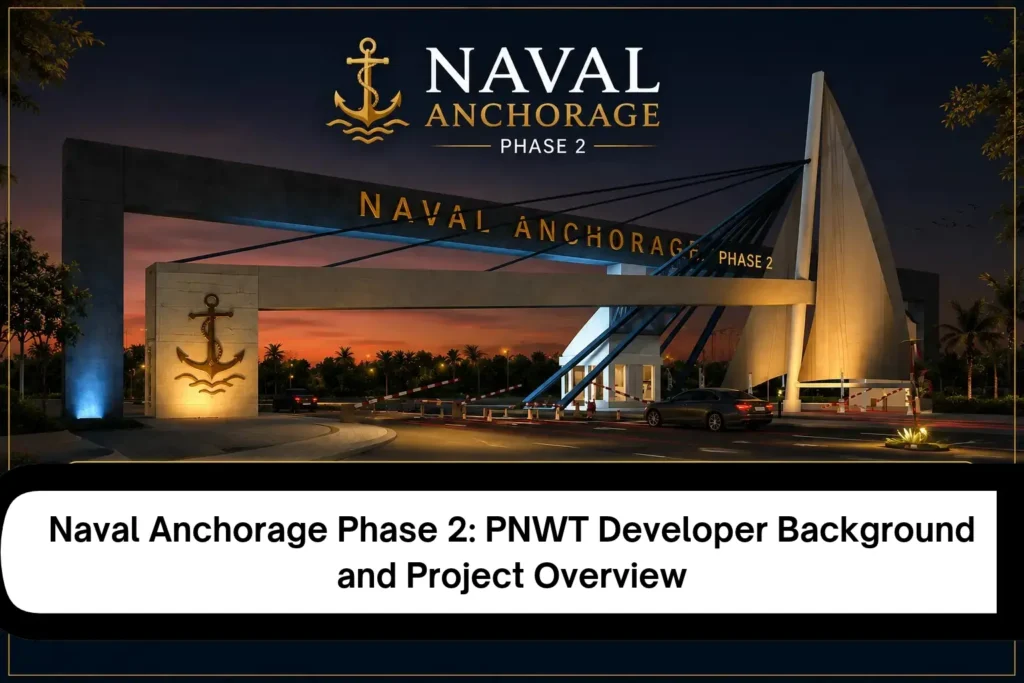
The Naval Anchorage Developer question matters because a familiar project name does not establish who holds legal responsibility for a plot. In Naval Anchorage Islamabad, buyers need to understand Pakistan Navy Welfare Trust’s (PNWT) documented role and distinguish the original housing scheme from the separately marketed Phase 2. Official records can help clarify who the authorities identify and which approvals apply to the land.
This article looks at the Naval Anchorage Developer question through documents rather than brochures. It separates the original project from Naval Anchorage Phase 2, because each has its own records. It also explains what the Capital Development Authority (CDA) has put on record, and which checks a buyer should complete before paying. By the end, you will know what the evidence supports and where it stops.
Who Is the Naval Anchorage Developer?
Start with what the official records actually name. The CDA’s housing-society directory lists Naval Anchorage under Zone 5, with Mr. Rana Israr Ahmed, Director Anchorage (North), shown in the owner field. The address given is PNWA Plaza, Block-C (Ext), Naval Anchorage Housing Scheme, off Islamabad Expressway.
The CDA notice of 1 June 2026 uses different wording again. It is addressed to the Director Anchorages (North) and refers to the “Directorate of Naval Anchorages, Naval Headquarters, Islamabad.” In other words, the official documents reviewed name a directorate and an office-holder. They do not name Pakistan Navy Welfare Trust as the legal developer.
That distinction deserves attention. A trust, a naval directorate, a marketing website and a sales office can all appear under the same project name. However, each may carry different legal duties. A booking form might show one name while the payment instruction shows another. That mismatch does not prove wrongdoing, but the buyer must establish who holds authority.
For this reason, the Naval Anchorage Islamabad Developer question cannot be settled by the project name alone. The records checked identify the entity addressed by CDA. They do not show the exact legal relationship between that entity, PNWT and the sales channels promoting Phase 2. A signed agreement, an ownership document or a written authority letter would resolve that gap.
The project’s own pages describe their view of the question, and you can compare them with the official wording in our guide on the developer of Naval Anchorage Phase 2.
Pakistan Navy Welfare Trust: Background and Documented Role
Pakistan Navy Welfare Trust is the organization most often linked with Naval Anchorage in marketing and public discussion. Its general background and stated objectives should come from its own official publications. Those publications describe an institution, but they do not describe the legal status of one housing phase.
This review did not locate a CDA record that names PNWT as developer, landowner or sponsor of Phase 2. Likewise, the CDA directory entry and the 2026 notice do not mention the trust by name. That finding is limited to the records checked, and a later document may exist elsewhere.
In practical terms, an organization’s reputation and a project’s compliance are two separate questions. A respected institution can be connected with a project and still need a layout plan approved for each parcel. Moreover, institutional association does not establish land ownership, management responsibility or the right to allot plots.
Consider an example. A buyer sees a naval-linked name on a brochure and assumes the land is approved. The CDA does not work that way. It issues a layout plan and an NOC for a defined area, and anything outside that area needs its own approval.
So the trust’s background is useful context, nothing more. Buyers should ask for a document showing PNWT’s role in the specific phase they are considering. If the seller cannot provide one, the connection remains unverified. That is not a finding against anyone. It simply marks what has not been proven.
Naval Anchorage Islamabad: Original Project History and Recorded Approvals
The original scheme has a clearer paper trail. According to the CDA directory, Naval Anchorage sits in Zone 5 on GT Road and covers 3,702.70 kanals. The same entry shows the layout plan (LOP) approved on 27 February 2020. It also shows the NOC issued on 28 May 2020.
The CDA Board’s meeting of 21 May 2020 supports this timeline. Its minutes list a summary on issuing an NOC for the Naval Anchorage Housing Scheme in Zone 5, Islamabad, under agenda item 6.3. The summary text I reviewed does not show the final decision, so the directory entry remains the clearer record of the outcome.
These dates are worth separating. The layout plan date records when CDA approved a plan. The NOC date records when CDA permitted development under conditions. Neither date tells you when the organization was founded, when sales began or when construction started.
More importantly, these approvals cover a recorded area of 3,702.70 kanals. They do not automatically extend to every parcel sold under the Naval Anchorage name. The directory entry does not describe Phase 2 as part of that approval.
Later records also touch the original name. The 1 June 2026 notice, discussed below, refers to Naval Anchorage (Extension) in its subject line. Therefore the original approval and the extension land should be read as separate questions. This project history shows what was approved in 2020, and it stops there.
Naval Anchorage Phase 2: Developer Identity and Project Overview
Naval Anchorage Phase 2 is marketed as a large housing project near the Thalian interchange and the M-2 corridor. The location claim comes from the project’s own material. This review has not independently verified distances, travel times or the precise jurisdiction from that description, so buyers should check the land’s exact location with the authority. For the developer’s own presentation, see its location page and project map.
Details fall into three groups. The first group has official support. The CDA notice of 1 June 2026 names “Naval Anchorage (Phase-II),” gives an approximate area of 5,500 kanals and places it in Zone 5, Islamabad. It addresses the Directorate of Naval Anchorages, Naval Headquarters.
The second group is developer-stated. Marketing material and some dealers cite a far larger figure, around 15,000 kanals. Project pages also refer to a master plan prepared by a recognized consultancy. These are claims, and this review found no official document supporting either one.
The third group stays unverified. This covers the exact legal developer for Phase 2, the landholding arrangement, the management structure and the entity receiving payments. No director list, ownership record or delivery history was located, so none is described here.
A master plan also needs careful reading. A consultancy can prepare a plan without the regulator approving it. Buyers can compare the marketed version on the master plan page, then ask CDA whether that plan was submitted and approved. Consultancy involvement, even if true, would not replace a layout plan approval.
Official Records, NOC Status and the Scope of Regulatory Approval
Regulatory status depends on the exact parcel, phase, block and authority. A layout plan is the approved document showing plots, roads and amenities. An NOC is a permission issued for a defined purpose and scope. A marketing master plan, by contrast, carries no regulatory weight by itself.
On 1 June 2026, CDA’s Directorate of Housing Societies issued a Final Show Cause Notice. The notice states that the Directorate of Naval Anchorages started development works without an approved layout plan and without a CDA NOC for “Naval Anchorage (Phase-II),” over approximately 5,500 kanals in Zone 5. These are CDA’s stated findings, not a conclusion drawn here.
The notice treats Block-A separately. It describes Naval Anchorage (Block-A) as approximately 435 kanals, also without an approved layout plan or NOC. CDA states that most of the Block-A land lies within the approved layout plan of Jinnah Garden (Phase-I Extension), sponsored by FECHS. The plan earmarks this land for public amenities.
The notice directs the addressee to stop development, marketing and sale and purchase, and to remove structures within seven days. It also offers a personal hearing within seven days. It lists possible further measures, including demolition, suspension of building plan approvals, and sealing of offices. Those are warnings of what may follow, and a notice does not prove any of them happened.
I checked the CDA directory and the notice itself on 20 October 2026. No later approval, withdrawal or enforcement record for Phase 2 was identified in those checks. That is a limit of the records reviewed, and it does not prove no such document exists. Buyers who want the position on the date they read this should ask CDA directly and review our page on Naval Anchorage NOC status.
Project Management and the Responsibilities of Each Party
Every transaction involves several roles. The developer carries out or arranges development. The project sponsor promotes or finances the scheme. The landowner holds the ownership rights. The management organization handles administration, and the marketing agent sells on someone else’s behalf. The development authority, here CDA, regulates planning.
One entity can fill several of these roles. However, a buyer should establish that through documents instead of assuming it. In the records reviewed, CDA addresses a naval directorate, while sales material uses the project name and an institutional association. Those are different layers.
Compare the name across every document you receive. Check the brochure, booking form, agreement, allotment letter and payment instruction. Each should name the same legal entity, or clearly explain the relationship between different ones. If an account name differs from the seller named in the agreement, ask for written authority before paying.
The recipient of funds matters because that entity takes on the contractual obligations. Keep receipts issued in that entity’s name. The developer’s own about page describes its view of its structure, but a company page does not replace a signed document.
The records reviewed do not establish a full management structure for Phase 2. This article therefore does not describe one.
Developer Claims Versus Verified Information
The table below shows what each type of claim needs behind it.
| Subject | Evidence to examine | What this review found |
| Organization’s background | Official organizational publications | Not located for this review; take from PNWT’s own sources |
| Original project approval | CDA directory and approval records | LOP 27 Feb 2020 and NOC 28 May 2020, covering 3,702.70 kanals |
| Phase 2 approval | Phase-specific CDA records | CDA’s 1 June 2026 notice states no approved LOP or NOC; no later approval identified |
| Developer identity | Agreements and organizational records | CDA addresses the Directorate of Naval Anchorages; legal developer of Phase 2 unconfirmed |
| Land area | Official records against project claims | CDA notice: about 5,500 kanals (Phase 2) and 435 kanals (Block-A); marketing: about 15,000 kanals, unverified |
| Master plan | Original plan plus approval record | Preparation claimed by the developer; approval not located |
| Development progress | Dated, verifiable evidence | Undated marketing is not independent proof |
| Possession and handover | Project documents | Allotment does not equal possession |
| Payment arrangements | Written terms and agreements | Check the current payment plan against the agreement |
Notice how the two land figures sit side by side. The 5,500 kanal figure comes from a CDA notice describing a specific area. The 15,000 kanal figure comes from marketing claims, and its scope is unclear. The figures may refer to different areas of land. Before comparing them, establish exactly which land each figure covers rather than assuming one is more accurate than the other.
What Buyers Should Verify Before Dealing With the Developer
Use this checklist before you pay any booking amount.
- Confirm the exact project, phase, block and plot number.
- Identify the legal entity offering the property.
- Obtain the ownership or land-rights documents.
- Verify the approved layout plan and NOC, where applicable.
- Confirm the approval covers the actual land being offered.
- Identify the development authority with jurisdiction over that land.
- Compare the developer’s name across the booking form, agreement, allotment papers and payment instructions.
- Verify the payment recipient and keep written receipts.
- Review installments, extra charges, cancellation rules and refund conditions.
- Ask for documentary evidence of progress or possession claims.
- Check official notices and any later orders.
- Take independent legal advice before a large commitment.
A familiar name on a document proves little. For instance, a certificate carrying “Naval Anchorage” may relate to the 3,702.70 kanal original scheme and not to the plot you are being offered. Ask which approved area the plot falls inside, and request the plan showing it.
One document is never enough. A dealer’s statement, a brochure or a single certificate leaves other questions open. Verify directly with the issuing authority, and use an independent property lawyer for the final review.
Plot buyers should also understand the difference between a plot and a file, because a file may carry different rights. Our guide on plots versus files explains what to ask. For updates as they appear, see the latest update page.
Is the Naval Anchorage Developer’s Background Enough to Establish Credibility?
Background matters, but it answers only one question. A strong institutional name helps buyers understand who may stand behind a project. It does not show that a specific phase has the permissions it needs. Credibility is better judged through separate questions.
Ask whether the organization is correctly identified. Check whether official records document the entity’s relationship with the project. Then identify the organization responsible for Phase 2 and verify whether the relevant authority has authorized it to develop or market the land.check that approvals cover the specific parcel and that your payment terms are clear.
On the present evidence, some answers are available and others are not. The original project has recorded CDA approvals. For Phase 2, the CDA notice of 1 June 2026 records the opposite position for the area it describes, and no later approval was identified in the records reviewed. The Naval Anchorage Developer question therefore stays only partly answered.
Uncertainty is not proof of misconduct, however. Equally, it is not confirmation that a project complies. Both readings go beyond the evidence. The sensible response is to ask for the missing documents, one by one, before money changes hands.
Final Verdict: What the Available Records Establish About Naval Anchorage Phase 2
The records reviewed show a clear split. For the original scheme, CDA lists a layout plan approved on 27 February 2020 and an NOC issued on 28 May 2020. That approval covers 3,702.70 kanals, and it does not describe Phase 2.
For Phase 2, the main official record is CDA’s notice of 1 June 2026. CDA states that no approved layout plan or NOC exists for the area it describes, and it addressed the Directorate of Naval Anchorages. No later approval or enforcement record was identified in the checks made. PNWT’s exact legal role in Phase 2 was not established.
Anyone considering this Naval Anchorage Developer should verify the legal entity, land documents, applicable approvals and payment arrangements for the specific plot before committing money. Confirm each point with CDA and an independent lawyer.
Frequently Asked Questions About the Naval Anchorage Developer
Q1: Who is the Naval Anchorage Developer?
Ans: The records reviewed do not name one clear legal developer for Phase 2. CDA’s notice of 1 June 2026 addresses the Directorate of Naval Anchorages, Naval Headquarters. Ask for the agreement that names the responsible entity. See our page on the developer of Naval Anchorage Phase 2.
Q2: Is Pakistan Navy Welfare Trust the developer of Phase 2?
Ans: This review found no CDA record naming the trust as developer, landowner or sponsor of Phase 2. Its link with the project comes from marketing and public discussion. A signed document would settle the question.
Q3: Is Naval Anchorage Phase 2 approved by CDA?
Ans: CDA’s notice dated 1 June 2026 states that Phase 2 (about 5,500 kanals) started without an approved layout plan or NOC. No later approval was identified on 20 October 2026. Check the current position with CDA and our NOC status guide.
Q4: Does the original approval cover Phase 2?
Ans: No, not automatically. The 2020 layout plan and NOC cover 3,702.70 kanals of the original scheme. Phase 2 needs its own records.
Q5: Why do the land figures differ?
Ans: CDA’s notice gives about 5,500 kanals for Phase 2. Marketing claims cite about 15,000 kanals, and no official document supporting that figure was located. The two may not describe the same land.
Q6: Does a show-cause notice mean the project was sealed or demolished?
Ans: No. A notice records CDA’s findings and warns of possible action. Each later step needs its own evidence. Follow our latest update page for changes.